
Emerging NDT Opportunities: 7 Growth Areas Driving the Next Decade

Why the Inspection Industry Is Heating Up
Nondestructive testing sits at the crossroads of safety, infrastructure, and innovation, and across the United States the demand for skilled NDT professionals is growing faster than the talent pool can keep up with. (BLS groups NDT under its broader quality control inspectors category, which projects 4 percent growth through 2032.)
At a Glance:
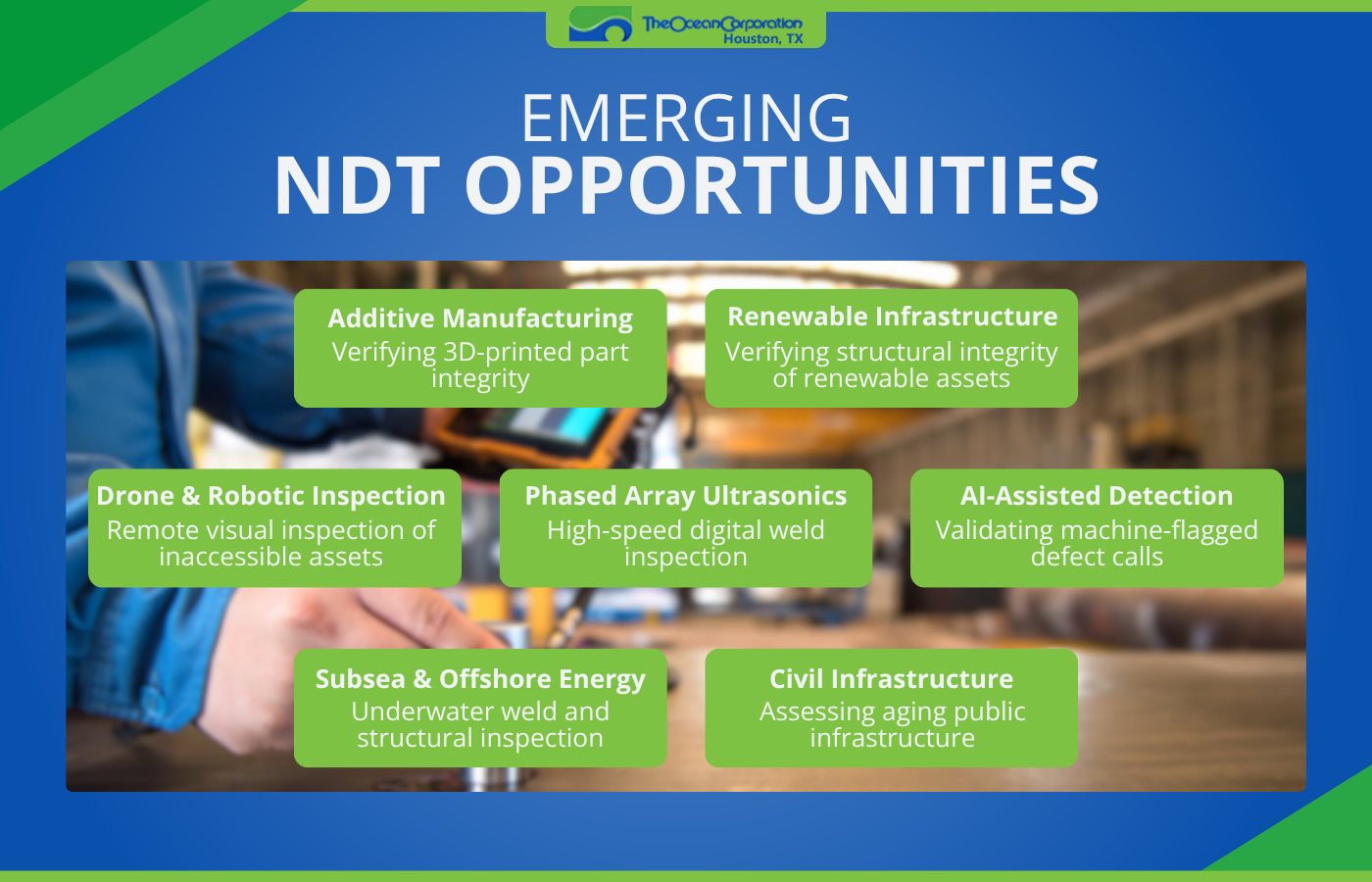
- Aerospace and additive manufacturing are creating inspection categories that didn’t exist a decade ago.
- Wind energy and renewable infrastructure need certified eyes on every blade, weld, and tower.
- Drone-based and robotic inspection is opening field roles for technicians who can pilot, scan, and interpret.
- Phased array ultrasonic testing is replacing legacy radiography in many high-volume environments.
- AI-assisted defect detection is reshaping what an NDT technician does day to day.
- Subsea and offshore energy work continues to demand top-tier inspection talent.
- Civil infrastructure spending is putting bridges, tunnels, and pipelines back at the top of the inspection schedule.
Each of these areas gives technicians a path into work with rising demand, better pay, and real industry impact. Here’s what’s driving each one and how you can position yourself to take advantage.
1. Aerospace and Additive Manufacturing
Commercial aviation backlogs, defense spending, and the rapid adoption of 3D-printed parts have turned aerospace into one of the highest-growth corridors for nondestructive testing. Printed components introduce internal porosity and bonding issues that traditional methods sometimes miss, so inspection teams are being asked to combine ultrasonic testing, computed tomography, and eddy current methods to verify part integrity. Major OEMs and their tier-one suppliers are adding inspection roles tied to both legacy aircraft maintenance and new builds.
How to Break In
Employers in this space favor multi-method NDT certification, especially UT and RT at NDT Level II or higher. Cross-training in CT scanning is a strong differentiator for newer technicians.
2. Wind Energy and Renewable Infrastructure
The U.S. wind fleet has grown past 150 gigawatts of installed capacity, and every turbine carries hundreds of welds, composite blades, and tower sections that need periodic inspection. Solar farms, hydrogen facilities, and battery storage sites are pushing new inspection categories into the mix as well. Wind blade work has become its own specialty corridor since technicians often climb the towers themselves or work from rope-access platforms, putting them in a work environment most office-based careers can’t match.
How to Break In
VT, ultrasonic testing, and infrared thermography are the methods most often requested for renewables work. Rope access certification adds a noticeable earnings premium.
3. Drone-Based and Robotic Inspection
Remote visual inspection has moved from niche to mainstream. Drones now inspect flare stacks, refinery columns, bridges, and storage tanks in a fraction of the time a human team would need, and ground-based crawlers are handling pipe interiors and tank floors. Companies like Gecko Robotics have built entire business models around robotic NDT.
Brian O’Leary, NDT Program Manager at Gecko Robotics and an Ocean Corp alumnus, took a less conventional path into the field:
It’s really changed my life. If you were to ask me 15 years ago or in my early 20s what I’d be doing now, I’d probably think I’d still be bartending. It’s completely turned my life around, been able to travel the world, seen almost all 50 states, and really just provided a great living for my wife, my son, and everything as a whole.
Brian O’Leary, NDT Program Manager, Gecko Robotics
How to Break In
A strong visual testing background combined with familiarity with drone platforms and inspection software puts you ahead of most applicants.

4. Phased Array and Advanced Ultrasonics
Phased array ultrasonic testing (PAUT) is replacing film radiography in pipeline construction, pressure vessel work, and shipyards. The advantages are speed, no radiation exposure, and digital records that any decision maker can review remotely. Experienced UT technicians who add PAUT and time-of-flight diffraction (TOFD) endorsements are finding themselves in demand across a wide variety of industries at once.
How to Break In
Earn UT Level II first, then layer on PAUT and TOFD coursework. Most of the highest-paying job postings in this category list those endorsements as preferred qualifications.
5. AI-Assisted Defect Detection
Machine learning models are now reviewing radiographs, ultrasonic scans, and drone footage to flag anomalies before a human takes a closer look. The role is shifting. NDT technicians are increasingly expected to validate AI calls, help train models with annotated data, and bring new ideas to how cutting-edge platforms get deployed in the field.
How to Break In
Traditional certifications remain the foundation. Technicians who add basic data literacy or experience with imaging software platforms are the ones moving into senior and lead positions fastest.
6. Subsea and Offshore Energy
The Gulf of Mexico still produces the bulk of U.S. offshore oil, and the platforms, risers, and pipelines that support that production all need ongoing inspection. Decommissioning aging assets and recertifying still-active ones has created steady employment for divers and surface inspection teams alike. Underwater NDT remains one of the few specialties that requires both diving credentials and inspection certifications, which keeps the candidate pool small and the pay strong.
How to Break In
Combining commercial diving training with NDT certifications opens doors that surface-only technicians can’t access. The Gulf Coast remains the densest hiring corridor in the country for this kind of work.
7. Civil Infrastructure Inspection
Federal infrastructure spending is funding bridge, tunnel, and water-system upgrades that hadn’t been touched in decades. State DOTs and engineering firms are bringing inspection in house or contracting it out at higher rates than the industry has seen in years. Ground-penetrating radar (GPR), magnetic particle inspection, and ultrasonic thickness gauging are all in heavy rotation across these projects.
How to Break In
Multi-method technicians who hold MT, UT, and GPR endorsements are the most flexible hires for civil work. State DOT contracts frequently require specific cert levels matching those held by ASNT-credentialed NDT professionals.
NDT Opportunities Overview
| Growth Area | Key Methods in Demand | Top Hiring Industries |
|---|---|---|
| Aerospace & Additive Manufacturing | UT, RT, ET, CT scanning | Commercial aviation, defense, OEM suppliers |
| Wind Energy & Renewables | VT, UT, IRT | Wind farms, solar, hydrogen, battery storage |
| Drone-Based & Robotic Inspection | VT, RVI, drone piloting | Refineries, bridges, storage tanks, pipelines |
| Phased Array Ultrasonics | UT Level II, PAUT, TOFD | Pipeline construction, pressure vessels, shipyards |
| AI-Assisted Defect Detection | UT, RT, data validation | Manufacturing, power gen, aerospace QA |
| Subsea & Offshore Energy | UT, MT, underwater NDT | Gulf Coast oil and gas, offshore wind, maritime |
| Civil Infrastructure | MT, UT, GPR | State DOTs, engineering firms, municipal utilities |
What It Takes to Succeed as a Modern NDT Technician
The methods are advancing, but the qualities employers look for in a technician haven’t changed much. Technical expertise still matters most, and so does the ability to communicate findings clearly to the engineers, project managers, and safety officers who act on your reports.
The traits that consistently separate successful technicians from the rest:
- Technical skills across multiple methods. Single-method technicians get pigeonholed. Multi-method certification opens up more career path options across more industries.
- Strong communication skills. Inspection reports drive million-dollar decisions. Vague or sloppy documentation slows projects and frustrates clients.
- Hands-on experience early. Classroom theory only gets you so far. Time on real equipment with real defects is what builds confident technicians.
- A safety-first mindset. Every credible employer treats safety as a baseline, and they expect the same from their technicians.
- Commitment to ongoing learning. Methods evolve, codes change, and the technicians who keep current stay valuable.
The entry bar for most programs is straightforward: a high school diploma or GED, the willingness to do field work, and a real interest in technical problem-solving. Age and background matter less than people think. Plenty of working nondestructive testing technicians came from retail, the military, or trades like welding and electrical work.
Where to Start Your NDT Career

The common thread across all seven of these NDT opportunities is simple: employers want technicians who hold multiple certifications, have hands-on experience, and can step onto a job site without a long ramp-up period. That’s where dedicated training pays off.
The Ocean Corporation has been training NDT professionals since 1969. The 30-week NDT program covers UT, RT, MT, PT, VT, ET, thermography, and GPR, plus X-ray safety and film interpretation, all in a single curriculum. Most competing programs cover two or three methods and leave graduates to fill the gaps on the job. TOC graduates walk into their first role with the full range of certifications these seven growth areas are hiring for.
Instructors come from the industries that do the hiring. Career services works with graduates for life, not just at graduation. And a network of more than 15,000 alumni working across every major inspection sector means you are never starting from scratch when it is time to find your next opportunity.
The Georgetown University Center on Education and the Workforce ranked The Ocean Corporation 9th nationwide for 10-year earnings return on investment in a study of over 4,500 institutions.
Andrew Furgason, now NDE Manager at Element Materials, put it this way:
I wouldn’t be where I’m at if I didn’t come to Ocean Corp when I did. The idea of waiting four to six years to get a career started just didn’t sit well with me. Where I’m at now, I’m truly six plus years ahead of where I would be.
Andrew Furgason, NDE Manager, Element Materials
If you’re ready to step into one of these fields, talk to an admissions advisor or explore upcoming start dates.
Frequently Asked Questions About NDT Opportunities
What is nondestructive testing?
Nondestructive testing is the process of inspecting materials, welds, and components for defects without damaging the part being tested. NDT methods include ultrasonic testing, radiography, magnetic particle inspection, dye penetrant, eddy current, visual testing, and infrared thermography. Across the United States, nondestructive testing professionals work in aerospace, energy, manufacturing, and infrastructure to keep critical systems safe and reliable.
How long does it take to become an NDT technician?
The fastest career path is through a focused training program. The Ocean Corporation’s NDT program runs just 30 weeks, which gets students through classroom instruction, hands-on experience with real equipment, and the certification process. Some technicians choose to layer on additional certifications later in their career to expand their tools and technical expertise.
What’s the difference between NDT Level I, Level II, and Level III?
NDT Level designations follow ASNT’s SNT-TC-1A guidelines. A Level I technician performs specific tests under supervision. NDT Level II professionals can set up and calibrate equipment, interpret results, and write inspection reports. Level III technicians manage NDT programs, develop procedures, and train others. Most field jobs in the United States ask for Level II at minimum.
Do I need a college degree to become an NDT technician?
No. Most NDT professionals start with a high school diploma or GED, then complete a focused training program followed by certification. The job rewards hands-on experience, strong communication skills, and a safety-first mindset more than it rewards a four-year degree. Many of the highest-paid NDT technicians never went to college.
What industries hire NDT professionals?
Aerospace, oil and gas, power generation, civil infrastructure, manufacturing, and shipbuilding all employ nondestructive testing technicians. Demand has been climbing in renewables, robotics, and additive manufacturing as well. The mix of industries means a certified NDT professional can move between fields without restarting their career.
What is the most in-demand NDT method?
Ultrasonic testing remains one of the most widely used inspection methods, especially with the rise of phased array ultrasonics. Magnetic particle inspection and radiography are also in heavy demand for welds and pressure equipment. Technicians who hold certifications across multiple methods generally see the strongest employment options and the most flexibility on the job.
Can I get NDT certification through online courses?
Online courses can help with code review and theory, but NDT certification requires documented hands-on experience with real equipment under qualified supervision. The best programs combine classroom and online learning with extensive lab time, which is why an in-person training program is still the most direct path into the field.

