
The NDT Inspection Process: How It Works Step by Step

The Short Version Before We Go Deep
An NDT inspection follows a defined sequence run by a certified technician: pre-inspection planning, surface preparation, equipment calibration, method application, interpretation against acceptance criteria, and documentation. Each stage exists so that defects get caught before they become failures, all without damaging the component being inspected.
At a Glance:
- NDT inspection evaluates a material, component, or structure for internal and surface defects without altering or destroying it.
- A standard inspection moves through six stages: planning, surface prep, calibration, method application, interpretation, and reporting.
- The method used (ultrasonic, radiographic, magnetic particle, and others) is selected during planning based on material, defect type, geometry, and the governing code.
- Surface preparation and equipment calibration come before any data is collected, and skipping either is a common cause of missed defects.
- Interpretation is where training matters most, because not every indication is a rejectable defect.
- Every inspection ends in a documented report that may be reviewed by auditors or regulatory agencies for years afterward.
- For full definitions of each method and the industries that rely on NDT, see our Complete Guide to Nondestructive Testing.
- The Ocean Corporation trains technicians in every major method in a single 30-week program.
NDT inspection is the process of evaluating the condition of a material, component, or structure without altering or destroying it. It keeps pipelines from leaking, aircraft from failing, and pressure vessels from rupturing without taking anything apart.
What an NDT Inspection Is
NDT inspection, short for nondestructive testing (also called nondestructive evaluation, NDE, or nondestructive inspection, NDI), is the process of assessing the structural integrity of a component and identifying defects without taking it apart or breaking it. The alternative, destructive testing, physically stresses a sample until it fails to measure material properties like tensile strength. That works in a lab, but it is not an option for a pipeline carrying oil or a wing spar on a commercial aircraft. NDT gives you the inspection data without sacrificing the component.
For the background on what NDT is, the materials science behind it, and a full comparison with destructive testing, see the Complete Guide to Nondestructive Testing.
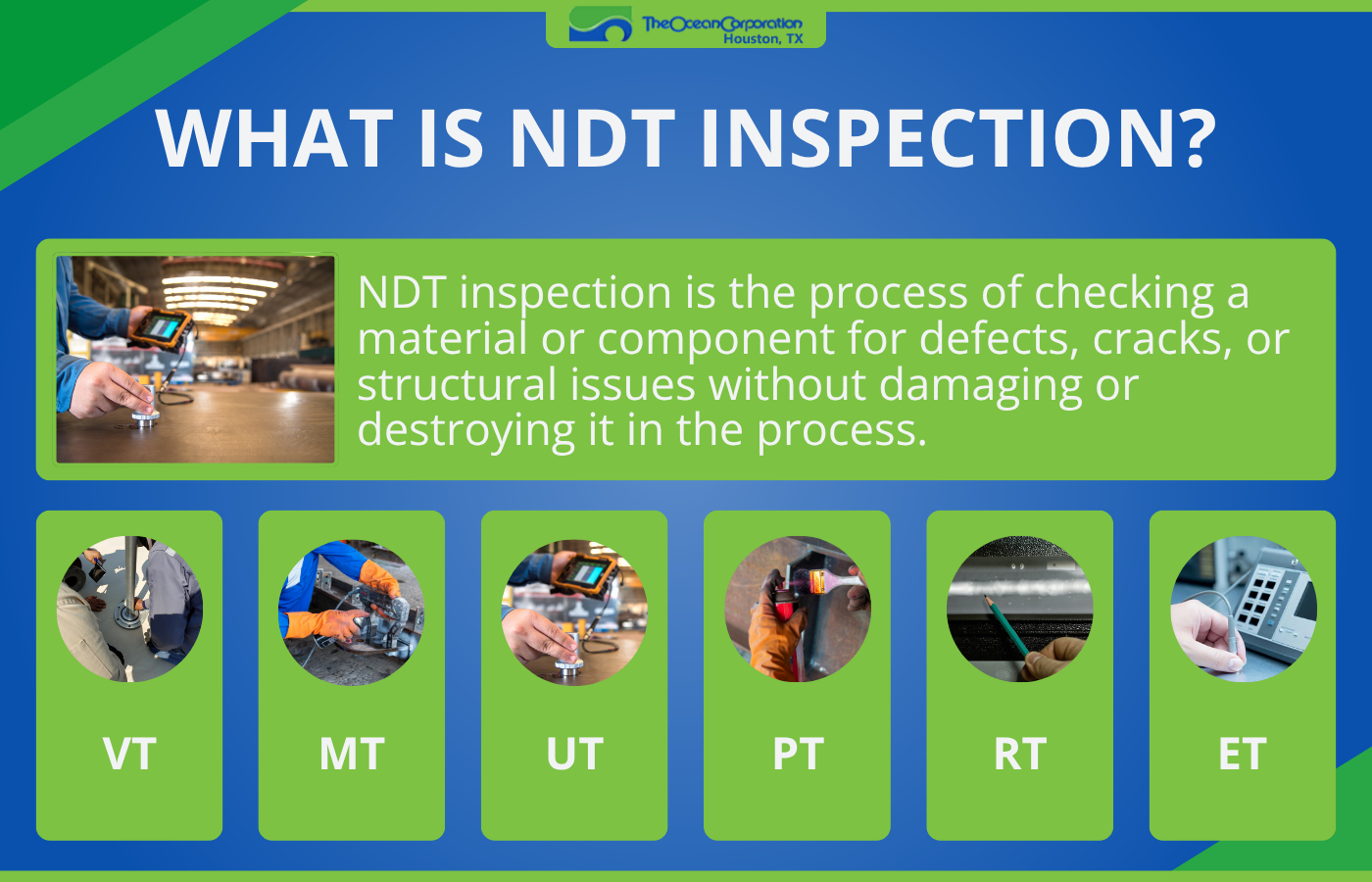
The Methods, in Brief
NDT is a family of methods, not a single technique. The right one is chosen during planning based on the material, the defect type, and what the inspection standard requires. Here is a one-line reference, with each method linked to a deeper breakdown:
- Visual testing (VT): Direct examination by naked eye, magnification, or camera, usually the first step in any inspection.
- Ultrasonic testing (UT): High-frequency sound waves that detect internal defects and measure thickness, including in welds and composite materials.
- Radiographic testing (RT): X-rays or gamma rays that image internal structure.
- Magnetic particle testing (MT): A magnetic field on ferromagnetic parts that reveals cracks through particle buildup.
- Liquid penetrant testing (PT): A dye drawn into surface-breaking defects by capillary action, then revealed with a developer.
- Eddy current testing (ET): Electromagnetic induction that finds surface and near-surface defects in conductive materials.
- Acoustic emission testing (AE): Real-time monitoring of stress waves from active defects under load.
- Thermographic testing (TT/IRT): Infrared imaging that catches temperature variations pointing to developing issues.
How an NDT Inspection Works, Step by Step
Understanding NDT at a process level helps clarify why it requires trained, certified personnel rather than a general maintenance worker with a flashlight. Here is what a typical inspection involves, step by step.
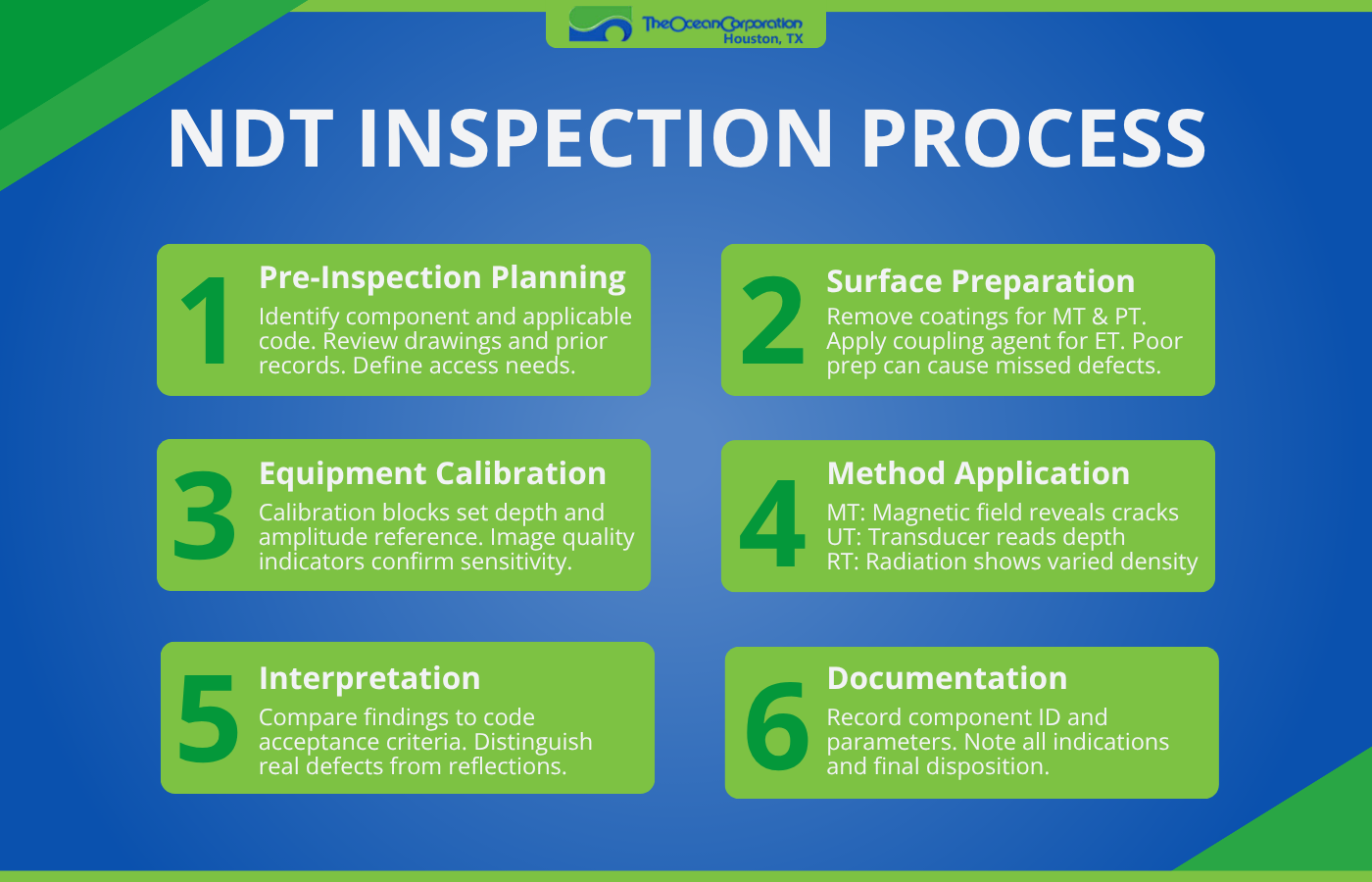
1. Pre-Inspection Planning
Before any equipment comes out, the NDT technician reviews the inspection scope. This includes identifying the component being inspected, the applicable industry standard or code (ASME, AWS, API, and others depending on the sector), the required NDT methods, and any access or safety considerations. For complex structures or critical components, this planning phase may involve reviewing engineering drawings and prior inspection records.
2. Surface and Environment Preparation
Many NDT methods require a clean, accessible surface to produce reliable results. In magnetic particle inspection or liquid penetrant inspection, coatings, rust, oil, and debris must be removed before the test medium is applied. For ultrasonic testing, coupling agents are applied to transfer the sound wave efficiently into the material. Poor preparation is one of the most common causes of missed defects.
3. Equipment Setup and Calibration
NDT equipment must be calibrated to a known standard before each inspection. In ultrasonic testing, calibration blocks with machined reflectors are used to set reference points for depth and signal amplitude. In radiographic inspection, image quality indicators confirm that the technique meets minimum sensitivity requirements. Skipping or shortcutting calibration undermines the integrity of the entire inspection.
4. Method Application
This is the active inspection phase. Depending on the method:
- In magnetic particle testing, a magnetic field is induced in the part and magnetic particles (either dry powder or liquid suspension) are applied. Leakage fields at cracks concentrate the particles, revealing defect location and shape.
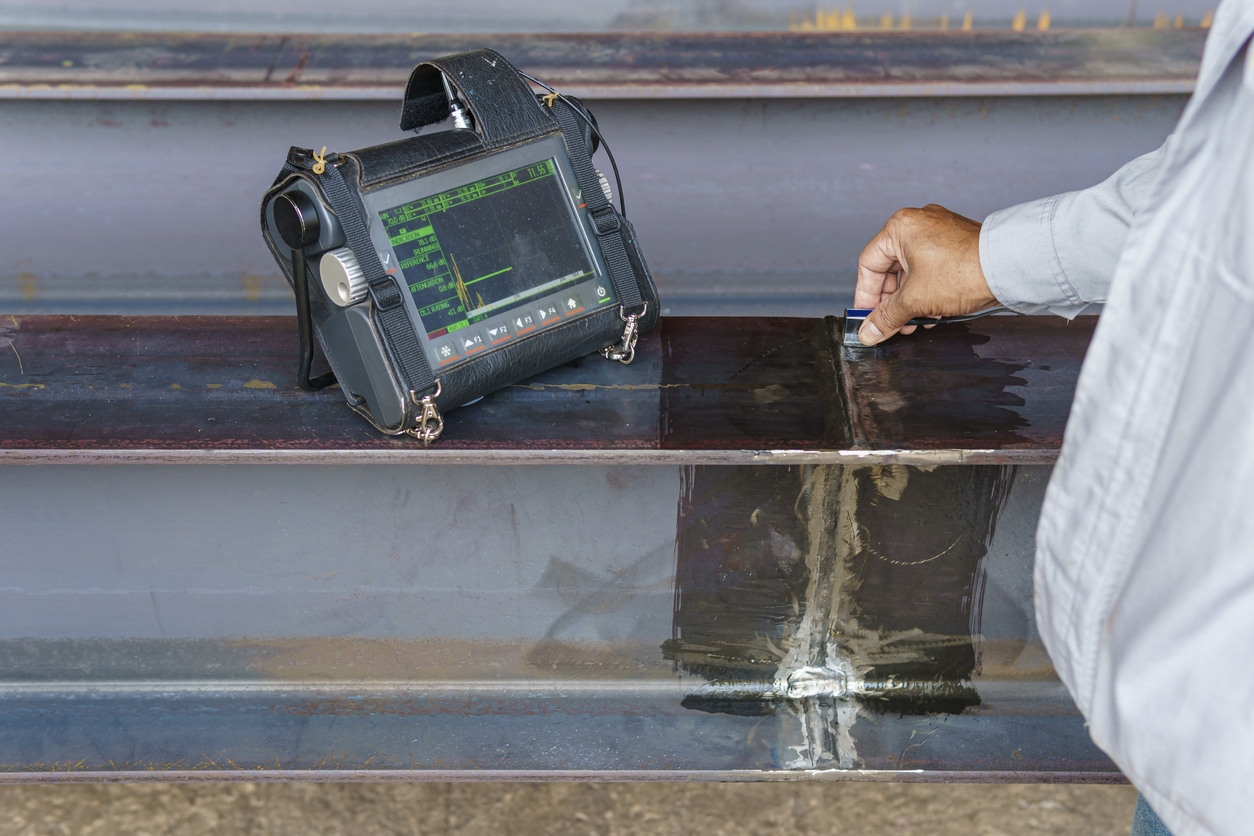
- In ultrasonic testing, a transducer sends sound waves into the material and receives reflected signals. The time of flight and amplitude of those reflections indicate the depth and size of reflectors.
- In radiographic testing, a radiation source is positioned on one side of the component and a detector or film on the other. Variations in material density (including voids, cracks, and inclusions) appear as density differences in the resulting image.
- In liquid penetrant testing, dye is applied, allowed to dwell, cleaned from the surface, and then developed. Any indications that bleed back to the surface during development reveal defect locations.
5. Interpretation and Evaluation
Collecting data is only half the job. The NDT technician must interpret what the data means. Not every indication is a rejectable defect. Some reflections are geometric, some indications are benign surface conditions. The technician compares findings against the applicable acceptance criteria in the governing standard and makes a call: accept, reject, or flag for further evaluation.
This is where training and experience matter most. A technician who cannot distinguish a relevant indication from noise, or who cannot correctly size and characterize a flaw, produces unreliable results regardless of how well the equipment performed.
6. Documentation and Reporting
Every NDT inspection generates a record. Reports typically include the component identification, method used, equipment and calibration records, technique parameters, any indications found, and the final disposition. In regulated industries, these records are kept for years and may be reviewed by third-party auditors, insurance inspectors, or regulatory agencies. Incomplete or inaccurate records are a compliance issue as much as a technical one.
Why the Process Matters
The discipline behind each step is what makes the result trustworthy. A skipped calibration or a missed indication on a pipeline weld, an aircraft component, or a pressure vessel can lead to environmental damage, loss of life, and enormous liability. The same rigor underpins quality control and quality assurance programs across various industries, from aerospace and power generation to oil and gas and manufacturing.
Demand for qualified technicians keeps growing as infrastructure ages, regulations tighten, and industries adopt advanced techniques like digital radiography, phased array UT, and automated scanning. Cutting-edge technology such as drones, robotic crawlers, and AI-assisted analysis is expanding what the field can do, but it raises the need for technicians who understand the fundamentals rather than replacing them.
Tommy Ripper, Co-Owner of Integrity Specialists and Ocean Corporation alumnus, put it plainly:
I didn’t even know what nondestructive testing was till I got here. Ocean Corp gave me the foundation to accelerate my career.
Tommy Ripper, Co-Owner of Integrity Specialists
That kind of career stability reflects the consistent demand for skilled inspectors across industries that cannot afford to cut corners on safety.
Where NDT Is Headed
The field is evolving. Digital radiography and phased array ultrasonic testing are replacing older analog techniques. Drones and robotic crawlers are handling inspections in hard-to-reach locations. AI-assisted analysis is beginning to support technicians in pattern recognition and defect classification. These advances are expanding what NDT can do, but they increase the need for trained technicians who understand the fundamentals, not replace it.
Start Your NDT Career at The Ocean Corporation
If this process breakdown sparked an interest in the field, NDT is a career path with real entry points that do not require a four-year degree. In fact, the Georgetown University Center on Education and the Workforce ranked The Ocean Corporation 9th nationwide for 10-year earnings return on investment in a study of over 4,500 colleges. The Ocean Corporation has been training skilled technicians for over 55 years. The NDT training program covers all major NDT methods, including UT, RT, MT, PT, VT, ET, TT/IRT, GPR, plus X-ray safety and film interpretation in a single 30-week curriculum.
The program is designed for people who want to get trained, get certified, and get to work. Financial aid, VA benefits, and housing assistance are available for qualifying students.
If you are ready to learn what NDT inspection looks like from the inside, explore The Ocean Corporation and talk to an admissions advisor about next steps.
Frequently Asked Questions About NDT Inspection
What is the difference between NDT, NDE, and NDI?
They are different names for the same discipline. NDT (nondestructive testing) is the most common term in the United States. NDE (nondestructive evaluation) is widely used in nuclear, aerospace, and academic settings. NDI (nondestructive inspection) frequently appears in military and defense contexts. Some international markets and codes prefer one term over another, but the methods, certifications, and job functions are the same regardless of which abbreviation an employer or standard uses.
Do you need a degree to become an NDT technician?
No. Most technicians complete a formal training program, gain hands-on hours, and earn certification through organizations like ASNT. The Ocean Corporation’s program takes just 30 weeks to complete.
What industries hire NDT technicians?
NDT technicians work across aerospace, oil and gas, power generation, manufacturing, construction, defense, and transportation. Nearly any industry that relies on pressure vessels, pipelines, structural components, or welds has a need for qualified inspectors. The O*NET occupational profile for NDT specialists provides a breakdown of industries and job functions.
How do NDT technicians get certified?
Certification is typically earned through a combination of classroom training, documented field experience hours, and a written and practical exam. The most widely recognized standard in the U.S. is ASNT’s SNT-TC-1A, which defines Level I, Level II, and Level III qualifications for each NDT method.
Is NDT inspection required by law?
In many industries, yes. The /

 Emerging NDT Opportunities: 7 Growth Areas Driving the Next Decade