
Steel, Water, and Scrutiny: How Bridge Inspection Actually Works
The Short Version
Before we get into the trade, here is the picture in one breath. Bridge inspection is a federally regulated safety inspection practice that combines visual checks, nondestructive testing (NDT), and underwater commercial diving to catch problems before they turn into failures.
At a Glance:
- The U.S. has 623,218 bridges, and federal requirements call for regular inspection of every highway bridge on the National Bridge Inventory.
- Frequency of inspection runs up to 24 months for routine work and up to 60 months for underwater work, with risk-based options extending some intervals to 72 months.
- Certified bridge inspectors use NDT methods like ultrasonic, magnetic particle, dye penetrant, and visual testing to find cracks and corrosion you cannot see.
- Underwater bridge elements get checked by certified commercial divers, often in zero-visibility water.
- Entry to the trade runs through a commercial diving school or an NDT training course, typically 7 to 8 months long.
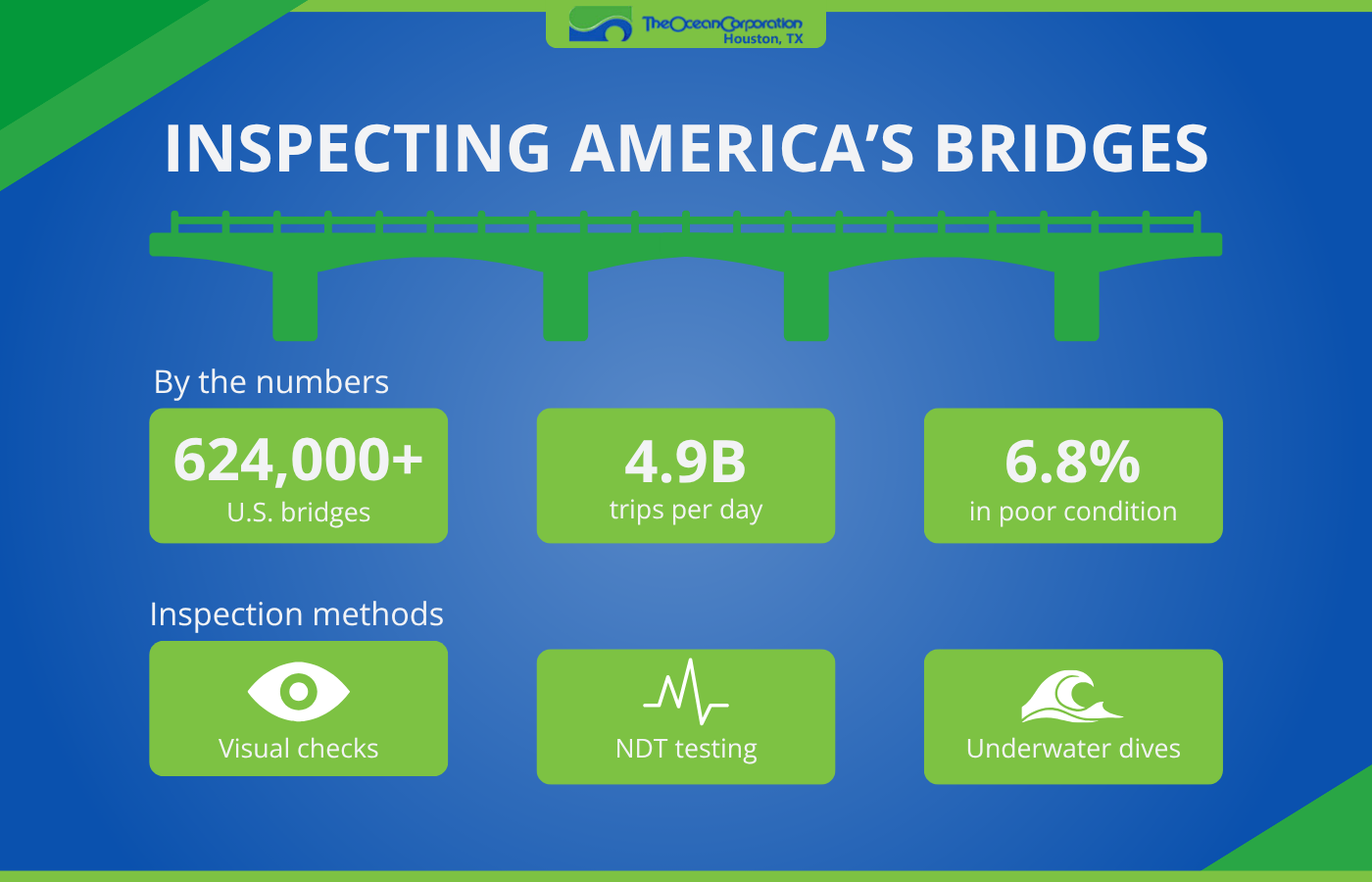
U.S. bridges carry roughly 4.9 billion motor vehicle trips per day, and 6.8% sit in poor condition. The people who walk, climb, and dive on these structures are the reason the rest of us cross them without thinking twice. (ASCE Infrastructure Report Card)
Why Bridges Get Inspected in the First Place
Bridges get inspected because steel rusts, concrete cracks, scour pulls soil away from foundations, and traffic loads keep climbing. The Federal Highway Administration runs the national bridge inspection program through 23 CFR Part 650 Subpart C, setting minimum requirements for inspection intervals, inspector qualifications, and inspection report content for every highway bridge in the country.
A few numbers explain the urgency:
- The 2025 ASCE Infrastructure Report Card rated U.S. bridges, with 6.8% in poor condition and roughly 45% past their 50-year planned design life.
- In 2024, 63,085 of the nation’s bridges were posted for load, meaning they carry restrictions on the weight of vehicles that can safely cross.
- The National Bridge Inventory describes 623,218 bridges on public roads, including Interstate Highways, U.S. highways, state and local roads, and publicly accessible bridges on federal and tribal lands.
Inspection catches deterioration early, supports load rating decisions, and feeds the bridge inventory database that bridge owners, the FHWA, and the public all rely on for safety planning and funding.
What the Federal Requirements Look Like
Federal regulations under 23 CFR Part 650 Subpart C set inspection intervals, training requirements for team leaders and program managers, and reporting standards for every bridge owner in the U.S. Every state transportation department, federal agency, and tribal government bridge inspection organization follows the same baseline National Bridge Inspection Standards.
Here is how the major inspection intervals compare under the updated NBIS rule:
| Inspection Type | Standard Interval | Risk-Based Range (Method 2) | Trigger for Reduced Interval |
|---|---|---|---|
| Routine | 24 months | 12 to 72 months | Poor condition, NSTM concerns, scour issues |
| Underwater | 60 months | 24 to 72 months | Underwater elements rated 3 or less |
| NSTM inspection | 24 months | 12 to 72 months | Tension member damage, fatigue concerns |
| Damage / Special | As needed | Event-driven | Vessel impact, flood, earthquake, vehicle strike |
The updated NBIS lets agencies set intervals using one of two risk-based methods. Method 1, a simplified risk assessment, caps extended routine and NSTM intervals at 48 months. Method 2, a more rigorous assessment approved by a risk assessment panel, allows routine, NSTM, and underwater intervals up to 72 months, while the highest-risk bridges stay on 12-month intervals. Underwater bridges with components in serious or worse condition, rated 3 or less, must be inspected every 24 months at most.
Team leaders must be a licensed Professional Engineer (PE), a licensed Structural Engineer (SE), or hold specific combinations of NICET certification, civil engineering experience, and an FHWA-approved training course. Underwater team leaders need diver-specific training and inspection certification on top of that. State DOTs also keep registries of qualified bridge inspectors for accountability.
How a Bridge Inspection Actually Unfolds
A bridge inspection is a documented walk-through, climb-through, and dive-through of every accessible bridge element on the structure. Inspectors record condition ratings on a 0-9 scale for the deck, superstructure, substructure, channel, and culvert (where applicable). Each rating and inspection date gets entered into the bridge inspection report and rolled up into the National Bridge Inventory.
A standard inspection process typically follows this sequence:
- File review of prior inspection reports, plans, and load ratings.
- Hands-on visual examination of the deck, joints, bearings, beams, and substructure.
- Targeted NDT on welds, pins, and fracture-critical members, including any complex feature flagged in the file.
- Underwater inspection of piers, abutments, and footings when applicable.
- Data collection with photos, sketches, measurements, and a written report.
- Critical findings reporting within 24 hours when an imminent hazard is identified.
Access and inspection equipment vary by bridge. Bridge inspectors use under-bridge inspection trucks (snooper trucks), rope-access rigging, lifts, drones, and dive gear depending on what the structure needs. Documented inspection procedures keep the work consistent from one team to the next.
NDT: Finding What You Cannot See
Nondestructive testing lets certified inspectors check the integrity of bridge components without cutting, drilling, or damaging anything. Six core NDT methods recognized by the American Society for Nondestructive Testing cover most bridge work: eddy current testing (ET), magnetic particle testing (MT), penetrant testing (PT), radiography testing (RT), ultrasonic testing (UT), and visual testing (VT). Infrared thermography (IRT) and ground-penetrating radar (GPR) round out modern toolkits.
How each method gets used on a bridge:
- Visual testing (VT): The first line. Trained eyes catch obvious cracks, section loss, deck spalling, paint failure, and bearing displacement.
- Ultrasonic testing (UT): High-frequency sound waves measure thickness in steel members and find internal cracks, weld flaws, and corrosion behind paint.
- Magnetic particle testing (MT): A magnetic field with iron particles reveals surface and near-surface cracks in structural steel components used in buildings, bridges, and other infrastructure.
- Dye penetrant testing (PT): Liquid dye seeps into surface cracks on non-porous materials. Common on aluminum, stainless, and other non-ferromagnetic components.
- Radiographic testing (RT): X-ray or gamma imaging that shows internal weld quality, used selectively because of safety controls.
- Ground-penetrating radar (GPR): Reads rebar position, identifies delamination, and maps voids in decks and substructure.
NDT findings often decide whether a bridge stays open at full load, gets posted for restricted weight, or shuts down for repair.
Going Underwater: Bridge Inspection Below the Surface
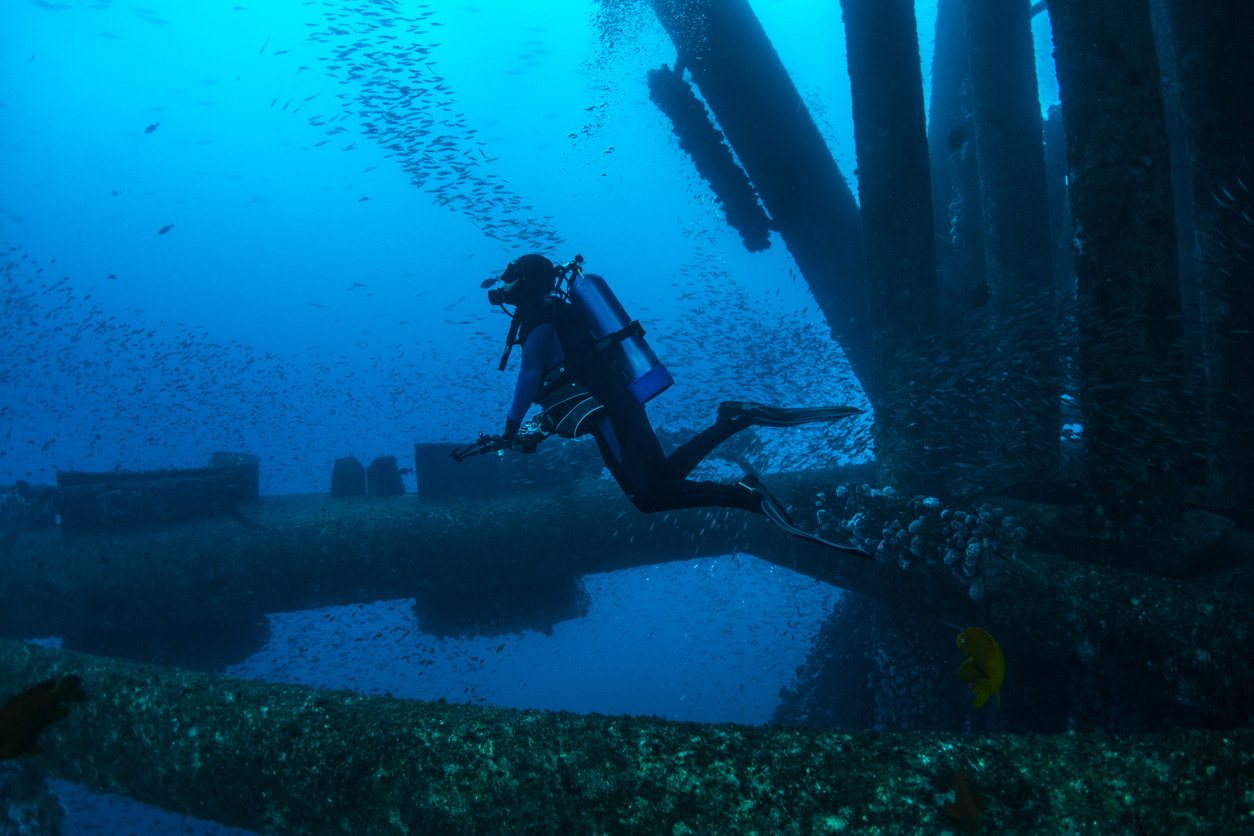
Underwater portions of a bridge cannot be checked from a snooper truck. They get inspected by certified commercial divers trained in bridge work, typically using surface-supplied air rather than scuba. The American Society of Civil Engineers Manual 101 defines three underwater inspection levels:
- Level I: Visual and tactile examination of all accessible underwater components.
- Level II: Detailed inspection requiring marine growth removal on roughly 10% of components, looking for section loss, undermining, and damage.
- Level III: A Level III inspection is the most highly detailed inspection type, typically used when a structural member’s integrity may be compromised, involving extensive cleaning, detailed measurements, and nondestructive or partially destructive testing using techniques ranging from sample coring to ultrasonics.
Divers often work in zero-visibility conditions, where everything happens by feel. Currents, debris, water temperature, and depth all factor into how the dive plan gets built. Underwater bridge inspection also overlaps with scour evaluation, since the area where the substructure meets the riverbed is where many bridge failures begin.
The same certified divers may also handle underwater welding, concrete jacket repairs, and pile encapsulation. Bridge work is one of the most consistent sources of inland diving demand in the country.
How to Get Into the Trade
The fastest legitimate route into bridge inspection runs through commercial diving school, an NDT training program, or both. Most students enter at 18 or older with a high school diploma or GED. Programs that meet the training requirements and put you in the field run roughly 7 to 8 months, far shorter than a four-year civil engineering degree.
A typical career path looks like this:
- Complete commercial diving training, NDT training, or both for the strongest underwater bridge inspection profile.
- Earn entry-level inspection certification: ADCI commercial diver card, IMCA card, and NDT Level I in chosen methods.
- Build hours and experience as an apprentice or tender on real projects.
- Progress to NDT Level II, then Level III in specialty methods, or to dive supervisor and team leader roles.
- Complete FHWA-approved training to qualify as a team leader on NBIS work.
According to the U.S. Bureau of Labor Statistics, commercial divers earned a median wage of $29.47 per hour ($61,300 per year) as of May 2023. The BLS projects employment for commercial divers to grow much faster than the average for all occupations through 2034 (BLS Employment Projections, 2024–34). NDT technician pay varies by methods and certifications, with senior techs and Level III specialists commanding the highest pay in oil and gas, aerospace, and infrastructure markets.
Brian O’Leary, an Ocean Corporation graduate and NDT Program Manager at Gecko Robotics, put it plainly:
University and college wasn’t for me, and it’s not a thing for a lot of people. Knowing there’s trade programs that require skilled talent, they’re highly understaffed these days. It’s completely turned my life around, been able to travel the world, seen almost all 50 states, and really just provided a great living for my wife, my son, and everything as a whole.
Brian O’Leary, NDT Program Manager, Gecko Robotics
That kind of career stability shows up across the alumni network. The bridges are not getting any younger, and the demand for trained bridge inspectors keeps climbing.
Build the Career That Keeps America’s Bridges Standing
If a career inspecting the infrastructure that billions of daily trips depend on sounds like the right fit, The Ocean Corporation has trained the people who do this work for more than 55 years. The Houston-based campus runs a 30-week Commercial Diving program and an NDT training program covering the full set of methods used in bridge inspection: UT, MT, PT, VT, RT, ET, IRT, and GPR.
Ready to take the next step?
- Talk to an admissions advisor about commercial diving or NDT training.
- Schedule a campus visit and see the dive tanks, NDT labs, and equipment up close.
- Ask about GI Bill benefits, Title IV financial aid, and state grant options.
Find out more at oceancorp.com and start the work that keeps America’s bridges safe.

