
NDT Level 1: What You Should Know

The First Rung on the NDT Ladder
Reaching NDT Level 1 is the moment you go from trainee to certified technician, and it sets the direction for everything that follows.
At a Glance:
- NDT Level I certifies you to run specific tests and record results under the direction of a Level II or III.
- Personnel certification in the United States is usually employer-based, following the ASNT recommended practice SNT-TC-1A.
- Getting there takes documented training courses, on-the-job experience, and passing three exams.
- You earn a separate Level I certification for each method, such as PT, MT, UT, RT, VT, and ET.
- Level I is the foundation for Level II, where independent interpretation and sign-off authority begin.
If you have spent any time around inspection work, you already know what nondestructive testing is. What is less obvious is what the Level I milestone actually certifies you to do, and how to reach it the right way.
On notation: ASNT formally writes these as Level I, II, and III; this guide keeps the Arabic form (Level 1, 2, 3) for readability and switches to Roman numerals only when naming a formal ASNT designation, such as ASNT Level III.
What NDT Level 1 Actually Means
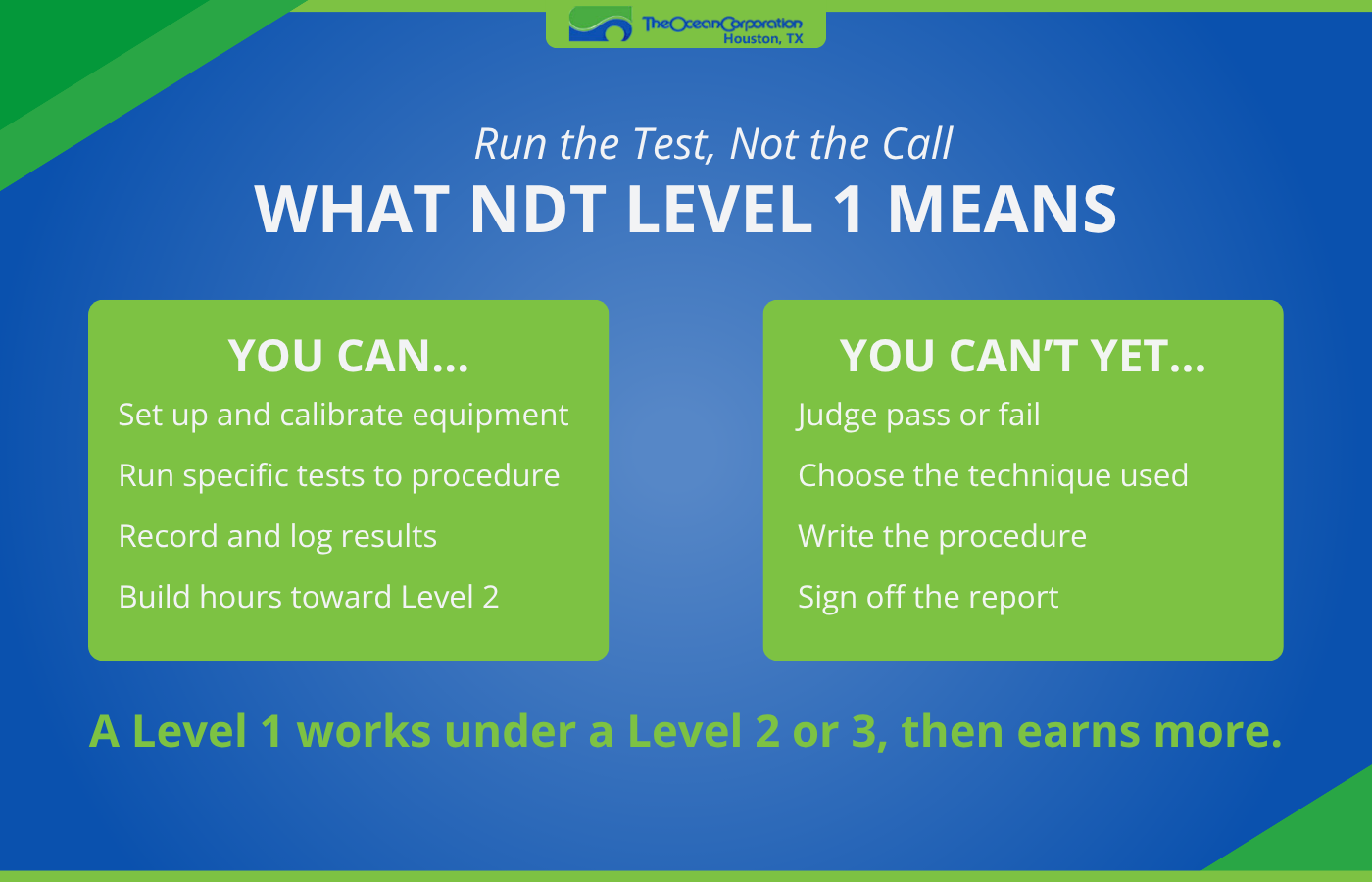
An NDT Level 1 technician is qualified to set up equipment, perform specific calibrations, carry out a specific NDT technique, and record the results, all under the direction of a Level 2 or Level 3. At this stage you follow the established work procedure rather than writing it, and you do not independently judge whether a part passes or fails.
That boundary is the defining feature of Level 1. Under ASNT‘s recommended practice SNT-TC-1A, the framework most U.S. employers use for personnel certification, a Level 1 technician performs specific calibrations and tests and records results while receiving instruction or supervision from a Level 2 or 3. Acceptance and rejection calls, technique selection, and procedure writing come later. Far from a limitation, that structure lets you build real competence on the equipment before the bigger decisions land on you.
Level 1 vs. Level 2 vs. Level 3
The three NDT levels describe increasing responsibility, not just seniority. Level 1 runs tests and records results under supervision. Level 2 sets up and calibrates equipment, interprets and evaluates results against codes, and reports them. Level 3, often an ASNT Level III, establishes techniques and procedures, interprets codes, and trains and examines Level 1 and Level 2 personnel.
| Level | What you can do | Supervision |
|---|---|---|
| Level 1 | Perform specific calibrations and tests, record results | Works under a Level 2 or 3 |
| Level 2 | Set up and calibrate equipment, interpret and evaluate results to code, report findings | Works independently, guides Level 1s |
| Level 3 | Establish techniques and procedures, interpret codes, train and examine others | Oversees the NDT program |
Knowing the ladder matters because employers staff around it. Trainees and Level 1 technicians generally work as helpers while they accumulate experience, and most NDT personnel need to reach Level 2 before they can work on their own and sign off on inspection results. Level 1 is where that progression starts, so treating it as a foundation rather than a finish line pays off.
How You Earn Level 1 Certification
Level 1 certification in the United States is usually employer-based, following the American Society for Nondestructive Testing recommended practice SNT-TC-1A. You document a set number of classroom training hours and meet an on-the-job experience requirement in a given nondestructive testing method, then pass three separate examinations: a general written exam, a specific written exam, and a hands-on practical examination.
The scoring is standardized. Under SNT-TC-1A, candidates typically must score at least 70% on each portion and at least 80% as a composite average, and the practical examination has you demonstrate the method on real specimens. A few things worth knowing about the certification process:
- It is employer-certified. SNT-TC-1A is a recommended practice, so your employer certifies you against their own written practice.
- Your eyes get tested. Near-vision and color-contrast checks are part of qualification and are commonly repeated each year.
- Hours vary by method. Training and experience requirements differ by method and your education level, so UT and RT generally call for more classroom time than PT or MT.
- Certification is not permanent. Technicians are typically recertified at five-year intervals.
Other certification schemes exist, including ASNT’s central CP-189 program and the ISO 9712 international standard, but SNT-TC-1A employer-based certification has been the most widely used framework in the United States since it was first published in the late 1960s. Your choice of training organization matters here, because the NDT course you complete supplies the documented hours your employer will certify against.
The Methods You Can Certify In
You do not become “a Level 1” in general. You earn a Level 1 certification in a specific testing method, and each one has its own training, exam, and uses. Most technicians start with one or two methods and add more over time. The core methods recognized under SNT-TC-1A are visual, penetrant, magnetic particle, ultrasonic, radiographic, and eddy current testing.
Here is the quick rundown:
- Visual Testing (VT): Direct or aided inspection of surface conditions, the starting point for most inspection work.
- Liquid Penetrant Testing (PT): A liquid penetrant draws surface-breaking flaws into view on nonporous materials.
- Magnetic Particle Testing (MT): A magnetic field and fine particles reveal surface and near-surface flaws in ferromagnetic parts.
- Ultrasonic Testing (UT): High-frequency sound waves find internal flaws and measure thickness.
- Radiographic Testing (RT): X-rays or gamma rays image the internal structure of a part.
- Eddy Current Testing (ET): Also called electromagnetic testing, it uses induction to detect surface and near-surface flaws and to measure conductivity.
Beyond these, methods like leak testing and infrared thermography expand what an NDT technician can inspect. The broader your method coverage, the more flexible your career, and advanced techniques like phased array ultrasonic testing build on the same Level 1 foundation.
Why Level 1 Is Worth the Effort
Level 1 is the entry point to a skilled trade that industries depend on and that rewards precision over seat time. NDT technicians verify the integrity of pipelines, aircraft, welds, pressure vessels, and power generation equipment, the kind of NDT inspection work where quality assurance is the whole job. Unlike destructive testing, which damages the part to learn about it, NDT keeps the component in service, which is why the U.S. Bureau of Labor Statistics tracks nondestructive testing specialists as a distinct occupation, a sign of how established the field has become.
The payoff shows up in how careers build. As Brandon Ford, an Ocean Corporation graduate and ASNT Level II in MT, PT, and RT, put it:
It’s definitely enabled me to do a lot of things that other people haven’t. I noticed a lot of people have to fight over positions and classes and things of that nature in order to get certs, whereas all of mine are already done.
Brandon Ford, ASNT Level II in MT, PT, and RT
Individual experiences vary, but the pattern is consistent among NDT professionals: get your certifications handled early, log your experience hours, and the path to Level 2 and beyond opens up.

How Training Gets You to Level 1
You cannot reach Level 1 on reading alone, because the classroom hours and hands-on practice are part of the requirement itself. A structured training program supplies the documented training hours, the equipment time, and the exam preparation that certification depends on. This is where a dedicated NDT course earns its place.
The Ocean Corporation has served as a training organization for the nondestructive testing industry since 1969, with more than 15,000 alumni working across the field. Its NDT training program covers the full method spectrum, including UT, RT, MT, PT, VT, and ET, with hands-on lab work on real equipment rather than theory alone. The Georgetown University Center on Education and the Workforce ranked The Ocean Corporation 9th nationwide for 10-year net present value among more than 4,500 institutions in its 2019 study, and the program is built to get students trained and into the workforce efficiently.
NDT Level 1 FAQ
What can an NDT Level 1 technician do?
Set up equipment, perform specific calibrations, run tests to a written procedure, and record results, all under the direction of a Level 2 or 3. Level 1 does not judge pass or fail or sign off reports.
How long does it take to reach Level 1?
It depends on the method and your training schedule. You need to complete the required classroom training hours and on-the-job experience for that method, then pass the exams.
Do I need a separate certification for each method?
Yes. You earn a Level 1 certification per method, such as PT, MT, UT, RT, VT, or ET, each with its own training and exams.
What exams are required?
Three: a general written exam, a specific written exam, and a hands-on practical examination. Under SNT-TC-1A, you typically need at least 70% on each and an 80% composite.
Does Level 1 certification expire?
Yes. Technicians are typically recertified at five-year intervals.
Is Level 1 the highest level?
No. It is the first of three. Level 2 adds independent interpretation and sign-off authority, and Level 3 oversees procedures and training.
Start Your NDT Career at Ocean Corp
Reaching NDT Level 1 is the first real step into a technical career with demand across energy, aerospace, manufacturing, and beyond. The fastest route there is structured, hands-on training that gives you the hours, the equipment time, and the method coverage that NDT certification requires.
If you are ready to build your foundation across the methods employers actually use, here is how to take the next step:
- Explore the Ocean Corp NDT training program and the methods it covers.
- Ask admissions about training hours, schedule, and financial aid options.
- Begin the path from trainee to certified Level 1 technician.
Your work will help keep critical infrastructure safe and verified, in industries that cannot operate without it. Start with the training that gets you certified and job-ready, and enroll in Ocean Corp’s NDT program today.

