
NDT Level 2 Certification: What It Is and How to Get There

Where the Calls Start Becoming Yours
If you are looking at nondestructive testing as a career, you will see “Level 2” (also written Level II) in almost every job posting. It is the level where an inspector stops following someone else’s instructions and starts making the call, setting up the equipment, interpreting what it shows, and putting their name on the report. This guide covers what the level means, how certification works in the United States, how many hours it takes in each method, and where it leads.
At a Glance:
- NDT Level 2 technicians set up and calibrate equipment, interpret results against codes and specifications, and report findings on their own.
- Most U.S. employers certify their own technicians under ASNT Recommended Practice SNT-TC-1A. Aerospace follows a separate standard, NAS 410.
- Qualifying takes documented classroom training, documented on-the-job experience, a vision exam, and three exams in each method.
- You can qualify directly to Level 2 without holding Level 1 first, as long as your hours cover both levels.
- Level 2 is the level most employers hire for, because it is the level that can evaluate results and sign the report.
What NDT Level 2 Actually Means
Under SNT-TC-1A, a Level 2 technician is qualified to set up and calibrate equipment, interpret and evaluate results with respect to applicable codes, standards, and specifications, and organize and report those results. Level 2 personnel are also expected to prepare written instructions and to provide on-the-job training and guidance to trainees and Level 1 technicians.
That last part defines the role. A Level 2 is the person a Level 1 asks when a reading looks wrong, and the person whose name goes on the report. Acceptance and rejection calls belong to the Level 2, within the procedure the employer has approved.
What sits above Level 2 is the program itself. Developing and approving procedures, establishing techniques, interpreting codes at the program level, and examining other personnel are Level 3 responsibilities. Level 2 works inside the NDT program. Level 3 builds it.
The NDT Certification Ladder: Level 1, Level 2, and Level 3
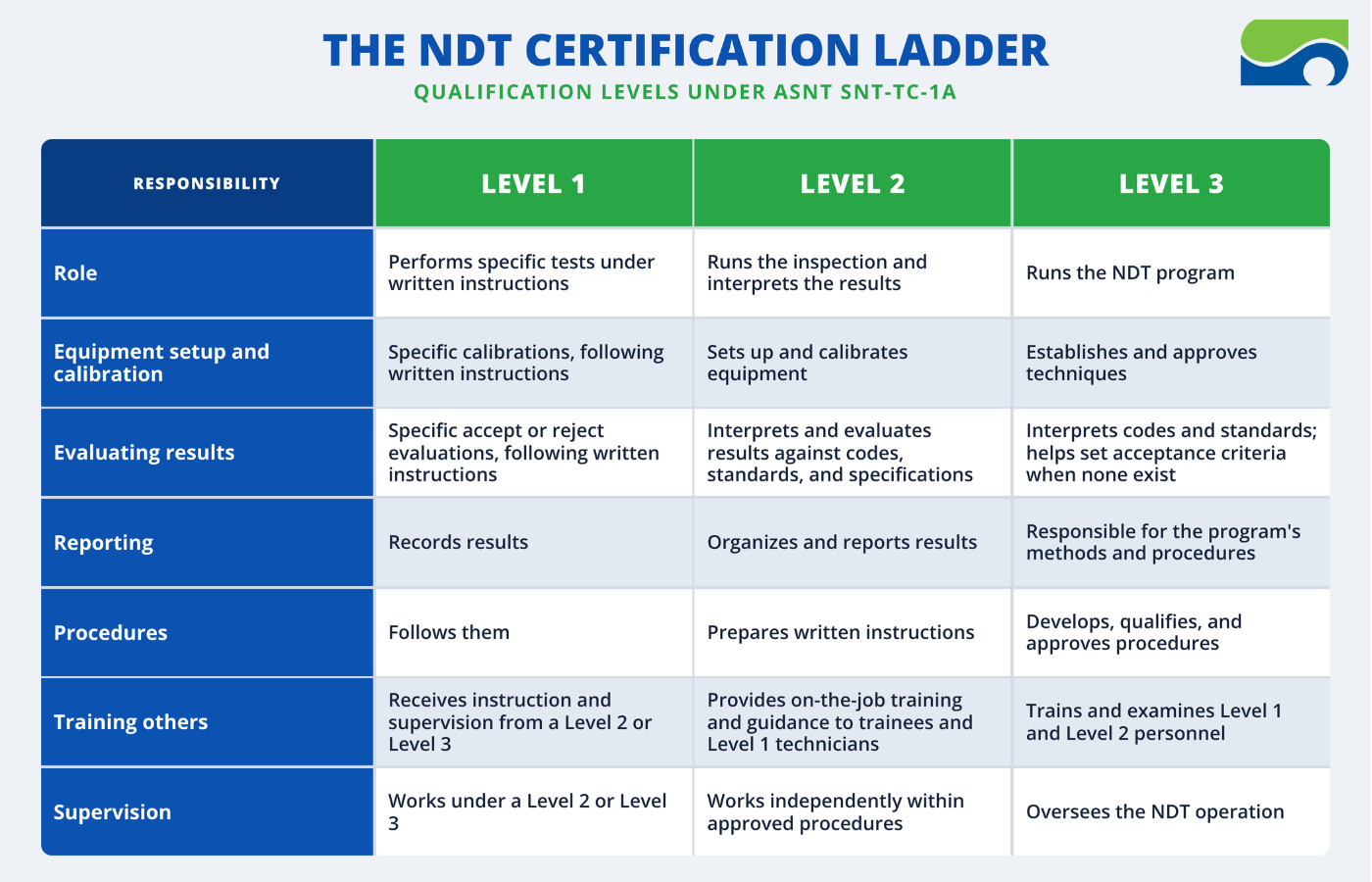
Employers staff around this ladder. A crew can carry trainees and Level 1 technicians, but someone on the job has to hold Level 2 in the method being used, because someone has to evaluate the indications and sign the report. That is why postings in in-service inspection, quality control, and fabrication so often list Level 2 as the minimum.
How NDT Certification Works in the United States
In the United States, NDT personnel certification is usually handled by your employer, following ASNT Recommended Practice SNT-TC-1A. The employer writes a document called a written practice, and that document sets the requirements you have to meet.
For each NDT method, Level 2 qualification comes down to four pieces:
- Documented training hours: Formal classroom instruction in the method, completed through a training course or a school program.
- Documented experience hours: Time on the job performing the method, logged by method rather than lumped together.
- A vision exam: Near vision every year, and color contrast at certification and at five-year intervals.
- Three examinations: A general written exam on the method’s fundamentals, a specific exam on your employer’s equipment, procedures, and codes, and a practical exam where you perform the method on real specimens and evaluate what you find.
SNT-TC-1A recommends a score of at least 70% on each exam and at least 80% as a composite average.
How Many Hours Level 2 Takes
Level 2 hours are cumulative. Qualifying directly to Level 2 means meeting the Level 1 and Level 2 hours combined, and the totals vary widely by method.
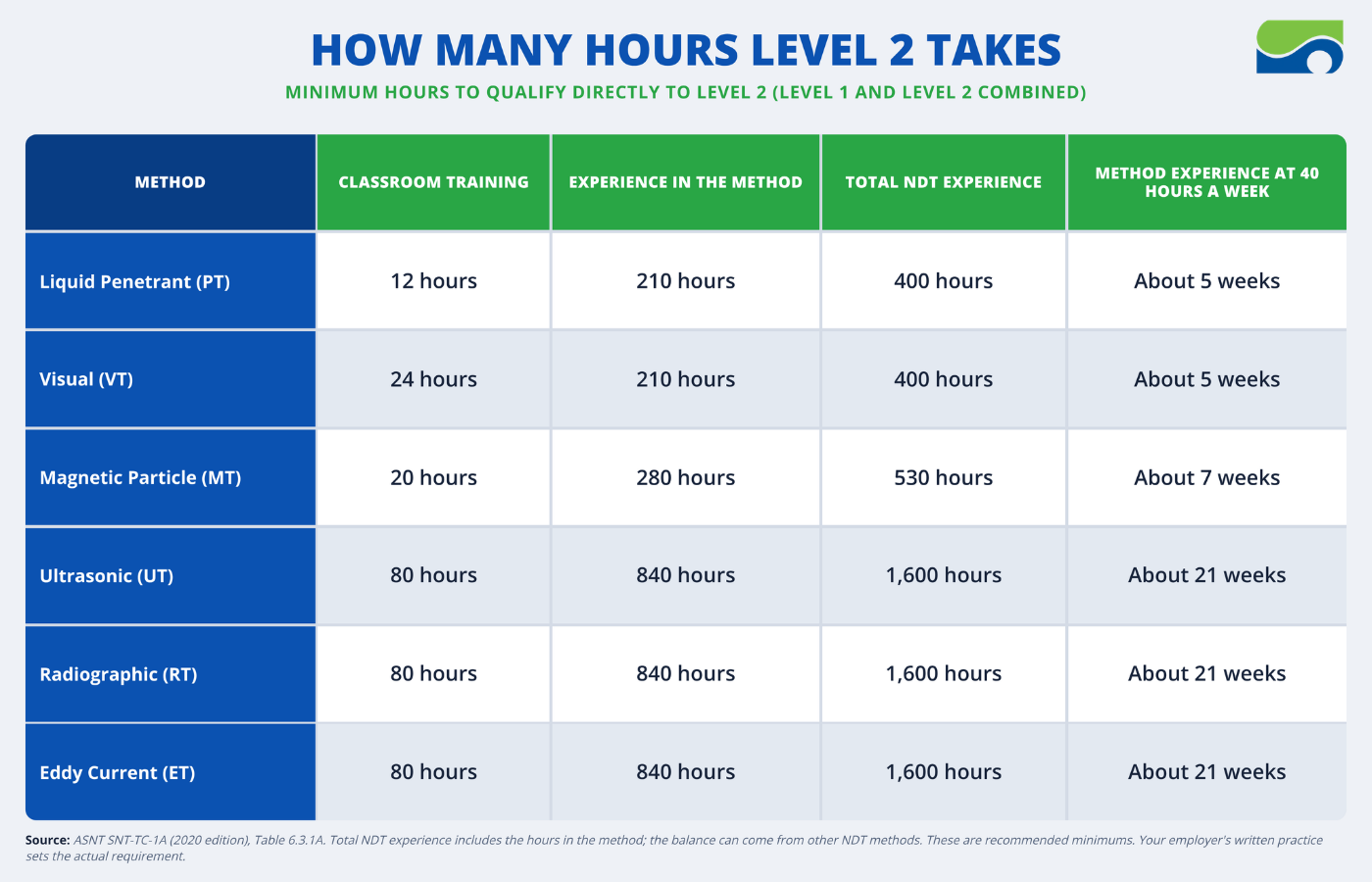
A few details that trip people up:
- Classroom hours can come first: Training hours are the one requirement you can complete before anyone hires you. Experience hours come from work. Some employers’ written practices also credit hands-on lab time beyond the training minimum toward experience, usually at a reduced rate. SNT-TC-1A leaves that decision to the employer, so it is worth asking how a prospective employer counts lab time.
- Certification is per method: You are not “a Level 2.” You are a Level 2 in UT, or MT, or PT. Each method has its own specific and practical exams.
- Certification expires: SNT-TC-1A sets a maximum recertification interval of five years.
- Your employer owns the certificate: When you change companies, the new employer usually reviews your documented hours and gives its own specific and practical exams. The documented hours are what you carry with you.
Other schemes exist. ASNT runs a central NDT Level II certification program with standardized exams, and ISO 9712 governs personnel certification in much of the world outside the United States. In aerospace, the governing standard is NAS 410, published by the Aerospace Industries Association. Unlike SNT-TC-1A, which is a recommended practice that each employer adapts, NAS 410 is mandatory and sets higher minimum hours in several methods, so hours logged under an SNT-TC-1A written practice do not automatically satisfy it. Outside aerospace, employer-based SNT-TC-1A certification is the framework most U.S. employers use.
Beyond Level 2: What Level 3 Takes
Level 2 is also the base for Level 3. Under SNT-TC-1A, a Level 3 candidate meets the Level 2 requirements and then adds experience comparable to Level 2 work, with the amount depending on education:
- A four-year degree in engineering or science, plus one additional year
- Two years of engineering or science study, plus two additional years
- No formal education requirement, with four additional years
The ASNT NDT Level III certification exam uses a similar scale, counted in qualifying days of at least seven hours each. That comes to 252 days with a bachelor’s degree, 504 days with two years of college study, and 1,008 days (roughly 7,000 hours) without a college background. In practice, most Level 3 technicians spend several years as a working Level 2 first, and the hours logged at Level 2 are what make Level 3 possible.
The Methods Where Level 2 Carries the Most Weight
Every method has a Level 2, but the interpretation demands are not equal.
- Visual Testing (VT): Direct and aided surface inspection, evaluated against acceptance criteria.
- Liquid Penetrant Testing (PT): Surface-breaking flaws in nonporous materials, where the call is telling relevant indications apart from bleed-out and background.
- Magnetic Particle Testing (MT): Surface and near-surface flaws in ferromagnetic parts, where field direction and part geometry both affect what shows up.
- Ultrasonic Testing (UT): Internal flaws and thickness readings, where the Level 2 handles calibrations, sizing, and signal interpretation.
- Radiographic Testing (RT): Film or digital images that require density checks, image quality verification, and defect interpretation.
- Eddy Current Testing (ET): Induction-based detection of surface and near-surface flaws, plus conductivity measurement.
Advanced techniques build on this foundation. SNT-TC-1A lists phased array ultrasonic testing (PAUT) as its own technique, with 80 classroom hours and 320 experience hours at Level 2, and it requires UT Level 2 certification first. The more methods you hold at Level 2, the more industries you can work in, since power generation, aerospace, pipeline, petrochemical, and manufacturing each rely on different combinations.
What Level 2 Opens Up
NDT technicians inspect pipelines, pressure vessels, aircraft components, welds, and structures that cannot be left to guesswork. Every one of those inspections eventually needs an interpretation, and interpretation is Level 2 work.
Brandon Ford, an Ocean Corporation graduate and NDT Level II in MT, PT, and RT, described what having his certifications in hand meant for him:
It’s definitely enabled me to do a lot of things that other people haven’t. I noticed a lot of people have to fight over positions and classes and things of that nature in order to get certs, whereas all of mine are already done.
Brandon Ford, NDT Level II in MT, PT, and RT, Ocean Corporation graduate
His point holds for anyone starting out. Employers have limited training budgets and course seats, and a new hire whose classroom hours are already documented does not have to wait for them. That technician can go straight to logging experience hours and sitting the employer’s exams.
How Training Shortens the Path
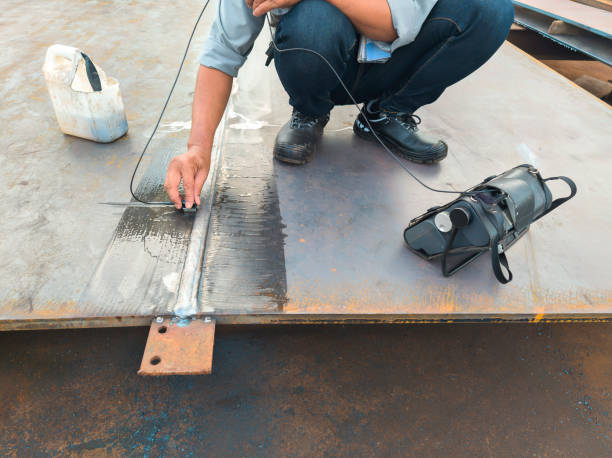
Reading about ultrasonic testing does not produce a calibration you can defend. Classroom hours and equipment time are written into the certification requirements themselves, which is why the training you choose matters.
The Ocean Corporation has trained technicians for the nondestructive testing industry since 1980, and its more than 15,000 alumni work throughout the diving and inspection industries. The NDT training program runs 30 weeks and covers the six core methods recognized by ASNT, plus infrared thermography (IRT) and ground penetrating radar (GPR), with classroom training for Level I and Level II in accordance with SNT-TC-1A. Training is hands-on, on real equipment, in labs. Classes run five hours a day, with morning, afternoon, and evening sessions, so most students keep part-time work while they train. New classes start every five weeks, and graduates have lifetime access to career services.
Georgetown University’s Center on Education and the Workforce ranked The Ocean Corporation 9th nationwide for 10-year return on investment (net present value) in its 2022 ranking of 4,500 colleges.
Take the Next Step Toward Level 2
Level 2 is the certification that lets you work independently, interpret results, and sign the report, and it is the level employers hire for across energy, aerospace, manufacturing, and in-service inspection. The first step is getting your classroom hours documented.
Request information about the NDT program. An admissions advisor will follow up with upcoming start dates, the class schedule, and the financial aid or VA benefits you may qualify for.
Frequently Asked Questions
How long does it take to get NDT Level 2 certification?
It depends on the method and on how quickly you log experience hours. The classroom training can be finished in school before you are hired. The experience hours come from work. Under SNT-TC-1A’s recommended minimums, a technician qualifying directly to Level 2 needs 210 to 280 hours of experience in the method for PT, VT, or MT, and 840 hours in the method (1,600 total NDT hours) for UT, RT, or ET. At full-time hours, that is a matter of weeks for the surface methods and most of a year for the volumetric ones.
Do I have to be Level 1 before I can become Level 2?
No. SNT-TC-1A allows a candidate to qualify directly to Level 2 with no time as a certified Level 1, as long as their training and experience equal the combined Level 1 and Level 2 hours.
Is NDT Level II the same as NDT Level 2?
Yes. ASNT writes the levels in Roman numerals (Level I, II, and III). Employers and job postings use both forms.
Who issues NDT Level 2 certification?
In the United States, usually your employer. Under SNT-TC-1A, the employer writes a written practice, administers the exams, and certifies the technician. ASNT also offers a central Level II certification that is not tied to a single employer, and it has its own training and experience requirements.
Does my Level 2 certification transfer if I change employers?
Not automatically. Because the certification belongs to the employer, a new employer typically reviews your documented training and experience and gives its own specific and practical exams. Your documented hours are what carry over, which is why keeping them on paper matters.
How long does Level 2 certification last?
SNT-TC-1A sets a maximum recertification interval of five years. Near-vision checks happen every year in between, and color contrast is checked at certification and at five-year intervals.
Does SNT-TC-1A certification work in aerospace?
Aerospace NDT follows NAS 410, a separate and mandatory standard with higher minimum hours in several methods. Hours logged under an SNT-TC-1A written practice do not automatically satisfy it, so technicians moving into aerospace should expect additional requirements.
Can I work while I train for NDT?
At The Ocean Corporation, NDT classes run five hours a day, Monday through Friday, with morning, afternoon, and evening sessions. Most students schedule part-time work around their class time.
